
Security Domain Model
The SDK ships a time-aware RBAC engine with optional explainability.
Authorization is defined as:
Authorization = f(App, Actor, Timestamp)Three inputs, one decision. No hidden state.
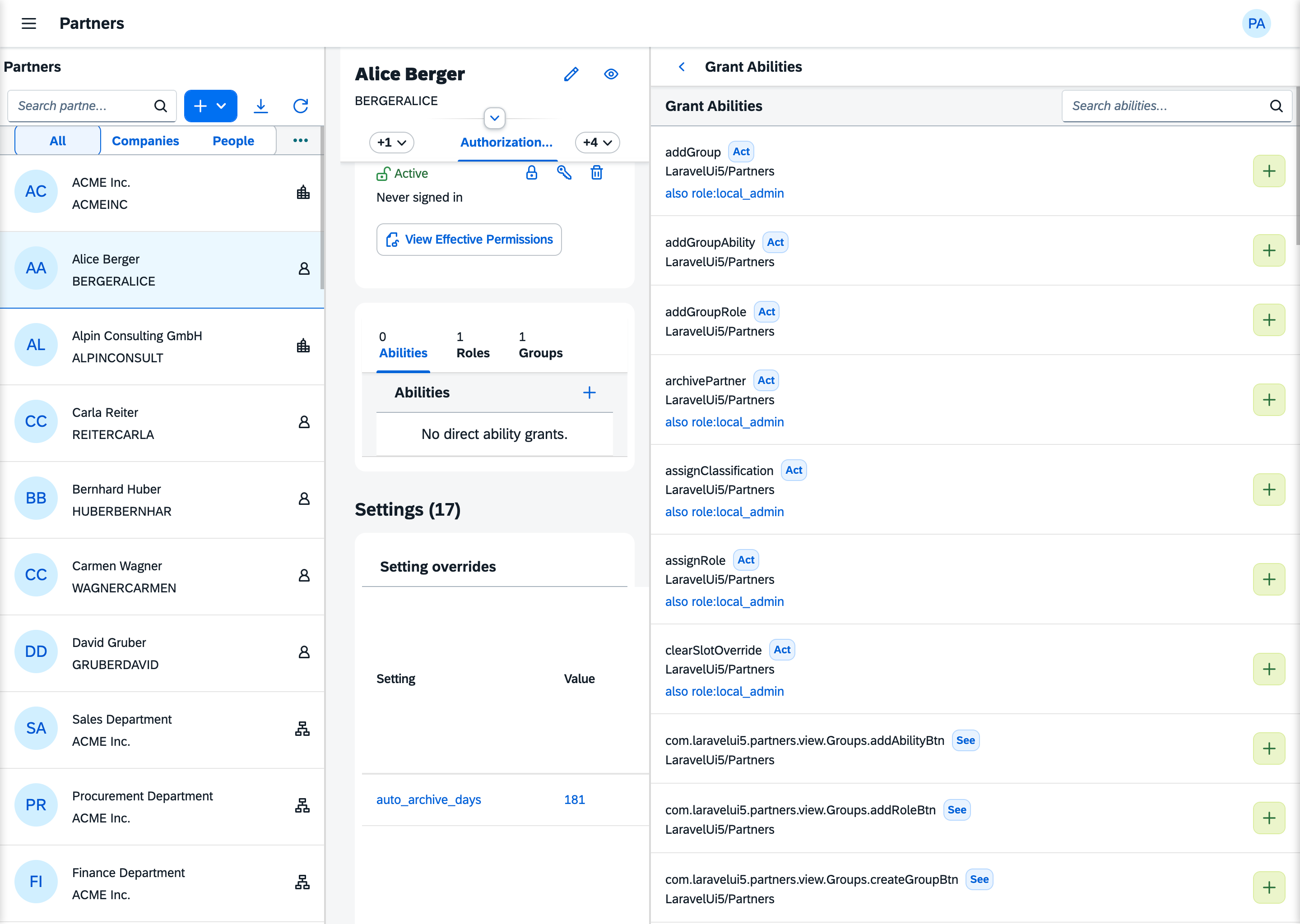
Core entities
Artifacts — sdk_artifacts
Every UI5 artifact (app, report, card, dashboard, …) is registered with:
namespace(unique, e.g.com.acme.accounting)type— the CoreArtifactTypeversionexpose— whether the artifact takes part in intent-based navigationtitle,description
Each Ability belongs to exactly one Artifact (App).
Abilities — sdk_abilities
idartifact_idability— semantic nametype— one ofAct,See,Access,Read
Unique per (artifact_id, ability, type). Act guards a backend operation, See the visibility of a UI element, Access entry into an artifact (app, card, report, …), and Read an OData entity set.
Roles — sdk_roles
role— unique semantic identifier- optional
scope— the model a role is held per (see Role Scope)
Role → Ability via sdk_ability_role.
Groups — sdk_groups
code— uniquedescription
Group → Role via sdk_group_role. Group → Ability via sdk_ability_group.
Groups are structural aggregators that combine roles and abilities into a single grantable unit.
Partners — sdk_partners
Represents business actors: users, organizations, teams. Multi-tenant arrangements live here.
Grant tables (time-aware)
All grants are time-bound:
valid_from
valid_until
No nullable timestamps. Defaults are enforced: the current time for valid_from, 9999-12-31 23:59:59 for valid_until.
| Table | Direction |
|---|---|
sdk_ability_assignments | Partner → Ability (direct grant) |
sdk_role_assignments | Partner → Role |
sdk_group_assignments | Partner → Group |
sdk_role_assignments also carries context_type / context_id: the scope of a role assignment (which customer, which territory). See Role Scope. Ability and group assignments carry no context. Impersonation delegations are stored separately, in the time-bound sdk_delegations table (see Impersonation).
Runtime context
Authorization always evaluates against an explicit context: SdkContext, which implements Core's Ui5ContextInterface. It carries:
artifact— the currentUi5ArtifactInterfacetenant— the currentTenantInterface(always present)actor— the partner whose grants are evaluatedprincipal— the authenticated identity (may differ from the actor under impersonation)localetimestamp— the moment authorization is evaluated
$context->at(): CarbonTime is part of the runtime reality. There are no internal Carbon::now() calls inside ability contributors — the timestamp comes from the context. This is what makes historical evaluation, time-bound grants, and deterministic tests possible.
Architectural principles
- Time-aware authorization
- Deterministic evaluation
- SQL-first performance
- Explainable security
- No hidden state
- Context-driven evaluation
- All abilities scoped to App
- Single union-based grant resolution
- Snapshot and Explain share the same SQL backbone
For the actual resolution algorithm, see Resolution Engine. For how the ability types shape the way you cut an application into apps, see Capability Mini-Apps.