
Impersonation
The SDK supports partner impersonation — a controlled, accountable mechanism that lets an authorized partner act as a colleague without logging out. Support staff reproduce a colleague's view to diagnose an issue; admins verify what a colleague can see; the acting partner never leaves their own login.
Impersonation is a first-class intent, not a middleware toggle. A principal triggers it by dispatching the built-in partner.impersonate intent; the intent authorizes the switch against a stored delegation grant and, on success, lands the principal on the Launchpad as the new actor.
Principal vs actor
Every request carries two identities on the runtime SdkContext:
- principal — who is really logged in (the person at the keyboard). It never changes during a session.
- actor — whose context the request executes in. It equals the principal normally, and is set to the impersonated partner while impersonating.
Authorization always resolves against the actor's grants — you see exactly what the target sees — while the principal stays the accountable identity. Impersonation never chains: the target is always resolved from the principal, never from an already-impersonated actor.
Delegations — who may impersonate whom
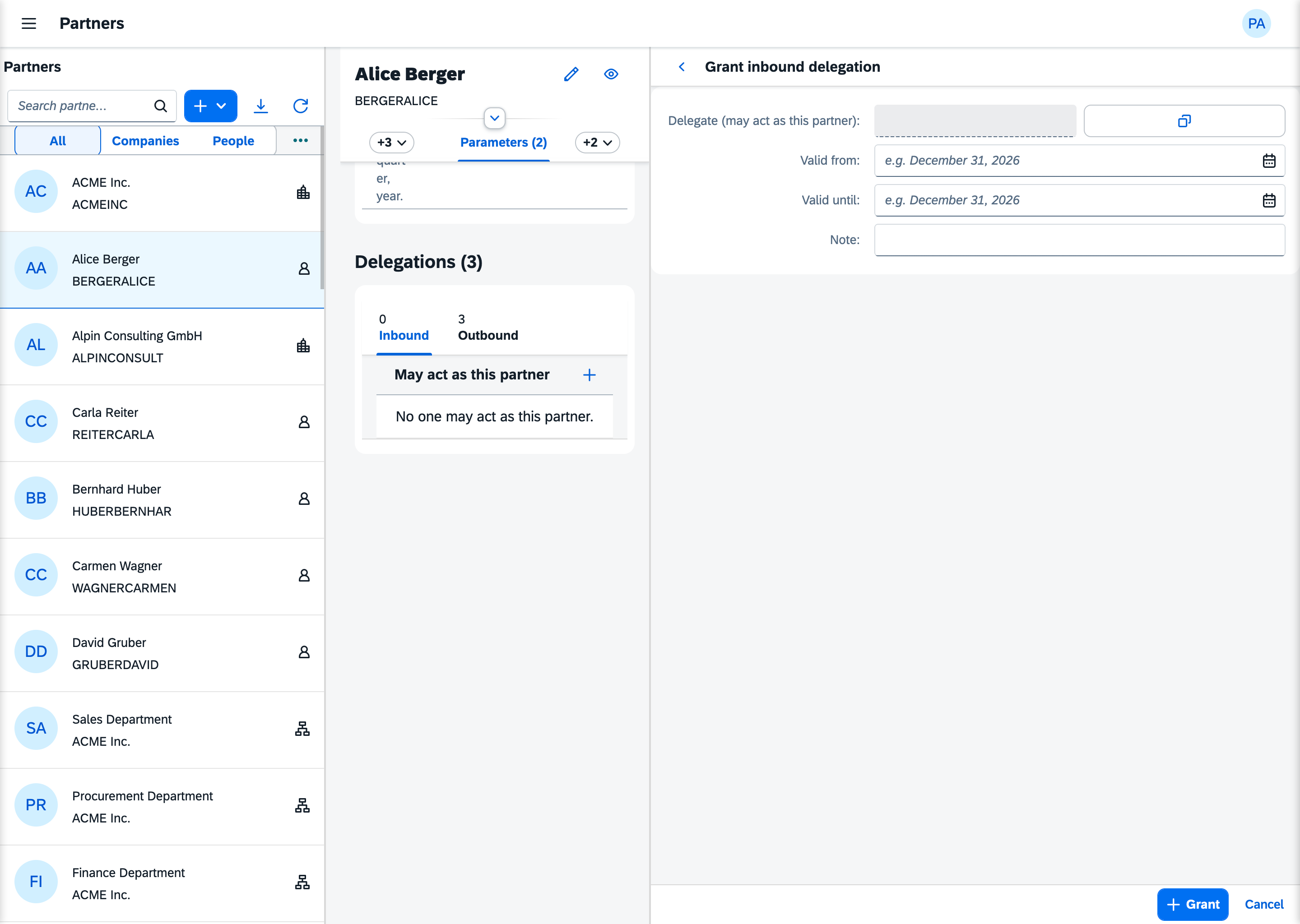
Impersonation is not an open capability; it is granted per pair, ahead of time. A delegation is a time-bound grant that names a delegate partner (who may act) and a target partner (the identity acted as):
- it is time-bound (
valid_from/valid_until) and records who granted it, - a partner cannot be granted a delegation to impersonate itself,
- active windows may not overlap for the same pair,
- grants form an accountable history: an active or elapsed delegation is end-dated (delineated), never erased; only a future, not-yet-started grant may be cancelled outright,
- granting and ending a delegation are
#[Act]-gated operations —grantDelegationanddelineateDelegation, attached to theLocalAdminrole.
The SDK does not restrict whom a delegation may name. ImpersonationService::grant() checks only the two rules above (no self-delegation, no overlap), and the Partners app offers any partner with a login as a candidate. Who may act as whom is the decision of the administrator who grants it.
Delegations are administered from a partner's record in the Partners app — the Delegations panel (In / Out) — which reads and writes them through the SDK's impersonation service.
The flow
- The principal opens their impersonation targets (the delegations granted to them) from the shell's identity menu.
- Selecting a target dispatches the
partner.impersonateintent. - The intent's
authorize()checks for an active delegation from the principal to that target. - On success the actor on the
SdkContextbecomes the target, and the handler answers with a full-page redirect to the named routedashboard. The SDK registers that route itself (GET /ui5/dashboard,web+authmiddleware); it redirects to the Launchpad — the mandatory safe-landing, because the target may not have access to the app the principal was in. The same route serves as the default post-login landing. - Ending impersonation restores the principal as the actor and re-lands on the Launchpad the same way.
Impersonation is session-scoped: it lives in the session, and ending or leaving it fully restores the principal's own context.
See also
- Domain Model — actor vs principal in the runtime context